Engineering Intelligence.
Built for Production.
Forgefront combines computational design, manufacturing engineering and process-chain intelligence to turn complex engineering concepts into production-ready components.
Engineering is still
fragmented.
CAD, simulation, additive, casting, forging, CAM, tooling, machining and inspection are each sophisticated on their own. The decisions between them are not. Every department solves its own problem — and the component inherits the gaps.
One component.
One manufacturing architecture.
Forgefront evaluates a component as one connected engineering system — from functional intent to final inspection. Manufacturing decisions are engineered together with the geometry from the start, not discovered after it.
- CategoryProcess-chain-aware engineering
- Designing the part and its production route together: which process creates which surface, where the datums come from, how the part is held, how much stock each face needs, and how every critical feature will be measured.
- The hardest industrial failures rarely happen inside a process. They happen in the hand-over between two of them.
- Process-chain engineering
Four disciplines.
One chain.
Geometry creation and manufacturing consequence, handled by the same engineering team — and progressively structured into software.
Advanced design
Create geometry around physics, functional requirements and manufacturing constraints — not convention.
Manufacturing engineering
Design components around the realities of manufacturing before production begins.
Process-chain engineering
Engineer the transitions between manufacturing processes — where many industrial failures actually occur.
Engineering automation
Structure manufacturing engineering decisions into scalable digital workflows.
Engineering intelligence, available today.
Engineering automation, being built for scale.
The logic being structured into the platform is applied today in client engagements. Customers do not wait for software — the software is built from what the engagements prove.
- Advanced design
- Manufacturing engineering
- Process-chain engineering
- DfHM
- Industrialization
- Rules
- Dependencies
- Process logic
- Risk models
- Decision frameworks
- CAD analysis
- Manufacturing reasoning
- Design guidance
- Process-chain recommendations
- Production strategy
Every engagement refines the methodology. Every refinement becomes a rule, a dependency or a risk model the platform can apply — faster, and across more process chains.
DfHM.
Where the platform began.
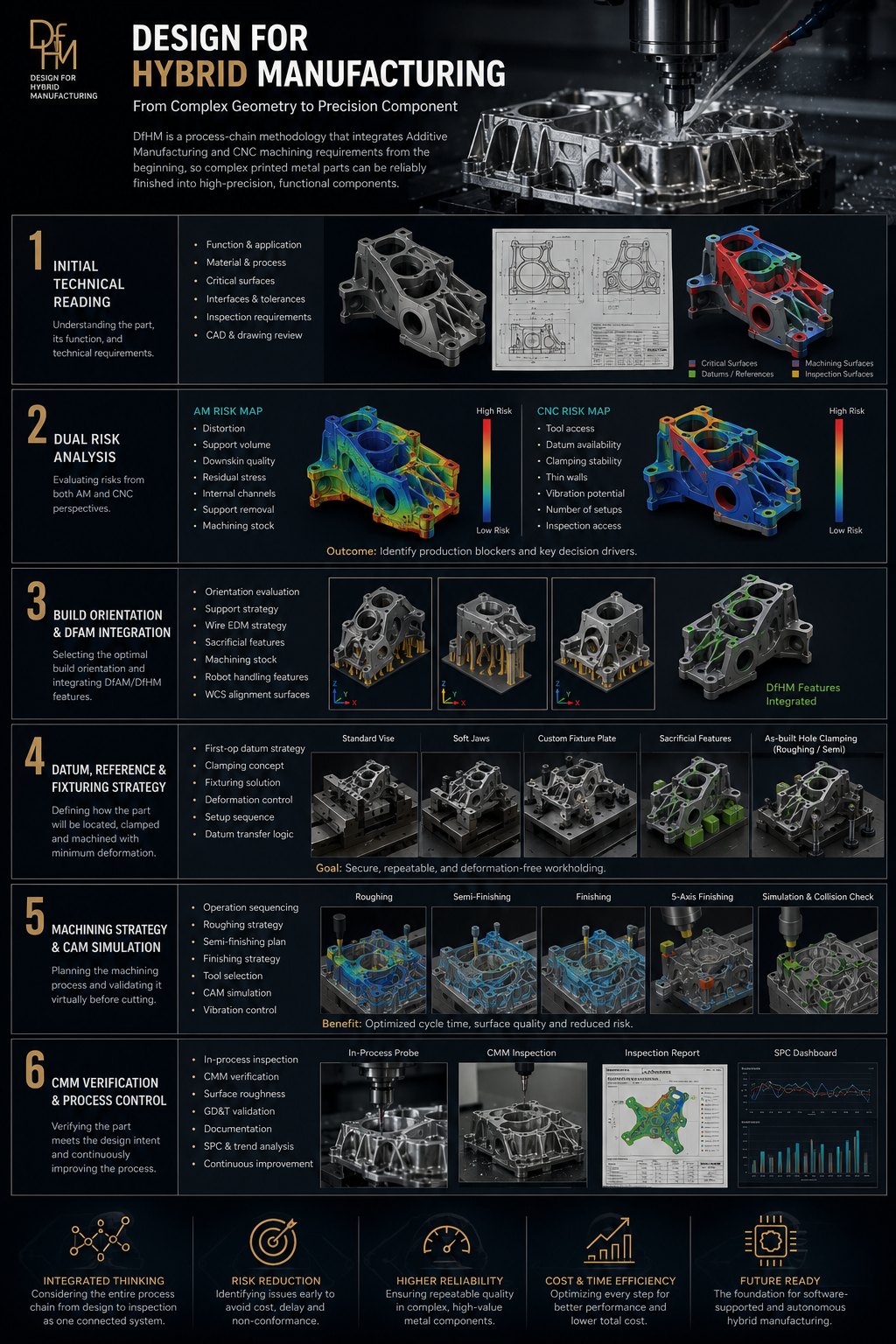
Design for Hybrid Manufacturing is Forgefront's first proprietary process-chain methodology — built around one of advanced manufacturing's hardest industrialization problems: turning additive near-net-shape parts into dimensionally verified finished components.
DfHM — applied in client work today.
Cast near-net geometry to verified part.
Forged envelope to verified part.
Further production routes on the same architecture.
Designed by engineers.
Grounded in production.
The platform thesis exists because the engineering behind it has been tested against real parts, real fixtures and real inspection reports.
Geometry driven by physics and constraints
Topology optimization, generative design, lattices and simulation — reconstructed into manufacturable CAD, not left as an optimization mesh.
AM, CNC, casting, forging and inspection
Datums, workholding, stock allowance, spindle clearance, GD&T and CMM probe access are first-class design inputs.
Engineering the transitions
The work concentrates on the hand-overs between processes — where generic DfM reviews stop looking.
Tested on physical parts
DfHM was developed in production and validated across 500+ metal parts in five alloys at a sub-1% defect rate.
From Turkey.
To the world.
Engineering presence in Turkey, Germany and the United States, working with customers and qualified production partners internationally.
From design intent
to production reality.
Advanced design, manufacturing engineering and process-chain engineering delivered as one discipline — so the geometry that leaves our desk is a geometry that can be built, held, machined and measured.
Advanced design
Computational engineering for components where weight, performance, geometry and manufacturing constraints must be solved simultaneously.
Generative design
Constraint-driven design exploration. We define what the part must do and what it must avoid, then evaluate the resulting design space as engineers — not as a gallery of shapes.
- Preserve geometry and interfaces
- Obstacle geometry and keep-out zones
- Load cases and boundary conditions
- Material candidates
- Manufacturing constraints per process
- Viable design alternatives
- Trade-space comparison (mass, stiffness, cost, route)
- Manufacturing adaptation of the selected option
- Engineering validation
Topology optimization
Load-path-driven material distribution for strength- and stiffness-to-weight. The optimizer's result is a starting point: we reconstruct it into clean, parametric CAD, re-validate it, and adapt it to the production route it will actually take.
Forgefront does not stop at an optimization mesh.
Lightweighting engineering
Weight reduction is a system-level engineering problem, not simply material removal. We choose the method by function, load and production route.
Lattice & cellular structures
Cellular geometry is used where it earns its place: a measurable engineering objective, a printable cell size, and a plan for powder removal and inspection.
- Energy absorption
- Thermal management
- Stiffness tailoring
- Mass reduction
Simulation-driven design
FEA is part of the design loop, not a report at the end of it. Every iteration is checked against both performance targets and manufacturing constraints.
Founder background
Advanced manufacturing and computational design training experience within the Autodesk ecosystem — covering generative design, topology optimization, additive manufacturing and advanced CAD/CAM workflows.
Design is only finished
when it can be produced.
We understand both how geometry is created and what it costs to make. Each capability below is applied to the drawing before it reaches a supplier.
Design for manufacturing
Geometry, tolerances and features reviewed against the capability of the intended process and supplier.
Design for additive manufacturing
Build orientation, support strategy, distortion risk, powder removal and post-processing access designed in.
Casting design engineering
Draft, fillets, wall transitions and machining allowance planned for a near-net cast blank.
Forging design engineering
Forging envelope, parting strategy, radii and machining stock set with downstream CNC in mind.
CNC & machining engineering
Setup count, tool access, spindle clearance, deflection and cycle-time drivers resolved at design stage.
Datum strategy
Reference geometry designed into the part so every operation and the CMM share one controlled datum chain.
Fixturing engineering
First- and second-operation workholding — sacrificial pads, built-in holes, soft jaws or custom plates — defined before the blank exists.
GD&T & tolerance architecture
Functional tolerancing, tolerance stack review and critical-to-quality characteristics tied to how the part is made.
Inspection strategy
CTQ points, probe access and the measurement plan defined with the design, not after machining.
Near-net geometry
to verified component.
Forgefront engineers the complete path from a cast or forged blank to a final, inspected part. Casting and forging themselves are produced by qualified foundry and forging partners selected per program.
- Draft, fillets and wall transitions
- Solidification-risk awareness in section design
- Near-net-shape definition and machining allowance
- Cast datum planning and machining access
- Workholding on as-cast surfaces
- Final tolerance strategy
- Forging envelope and draft
- Parting strategy and material-flow considerations
- Radii and section transitions
- Machining stock on functional faces
- Datum design and workholding
- Downstream CNC strategy
The hardest problems
live between processes.
Conventional software optimizes individual processes — a better build, a better toolpath, a better probe routine. Forgefront focuses on the engineering transitions between them.
What each transition must answer
- Primary process
Is the near-net shape defined with the next process in mind — orientation, distortion, as-built zones?
- Datum creation
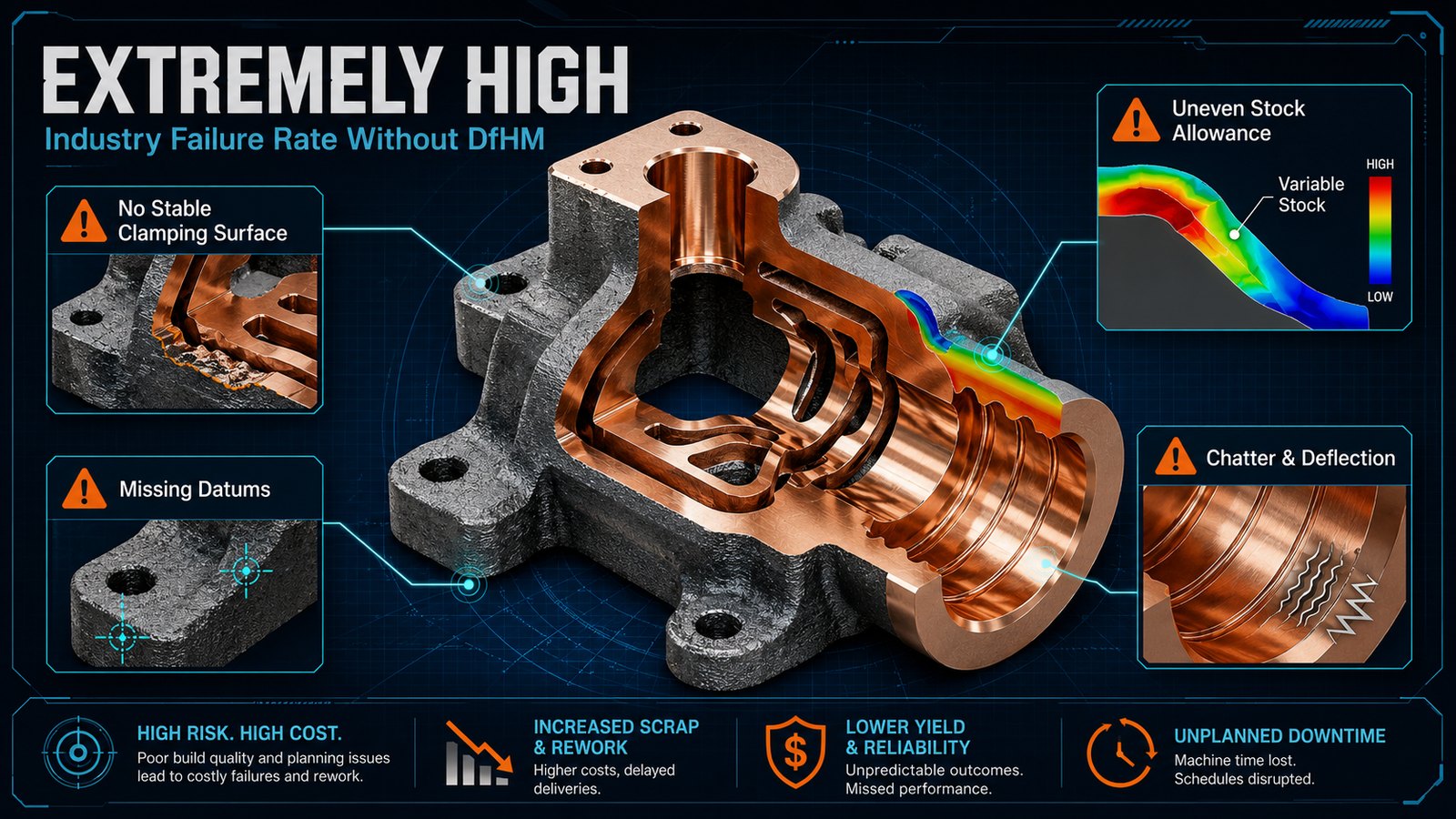
Does the next process have usable references on an irregular blank?
- Workholding
Can the component physically be clamped — rigidly, repeatably, without deformation?
- Stock removal
Is there enough stock on every machined face, including distortion and build drift?
- Critical features
Can tools reach critical surfaces with adequate spindle clearance, and is datum transfer controlled between setups?
- Inspection
Can the tolerances be verified, and can the inspection system reach every required feature?
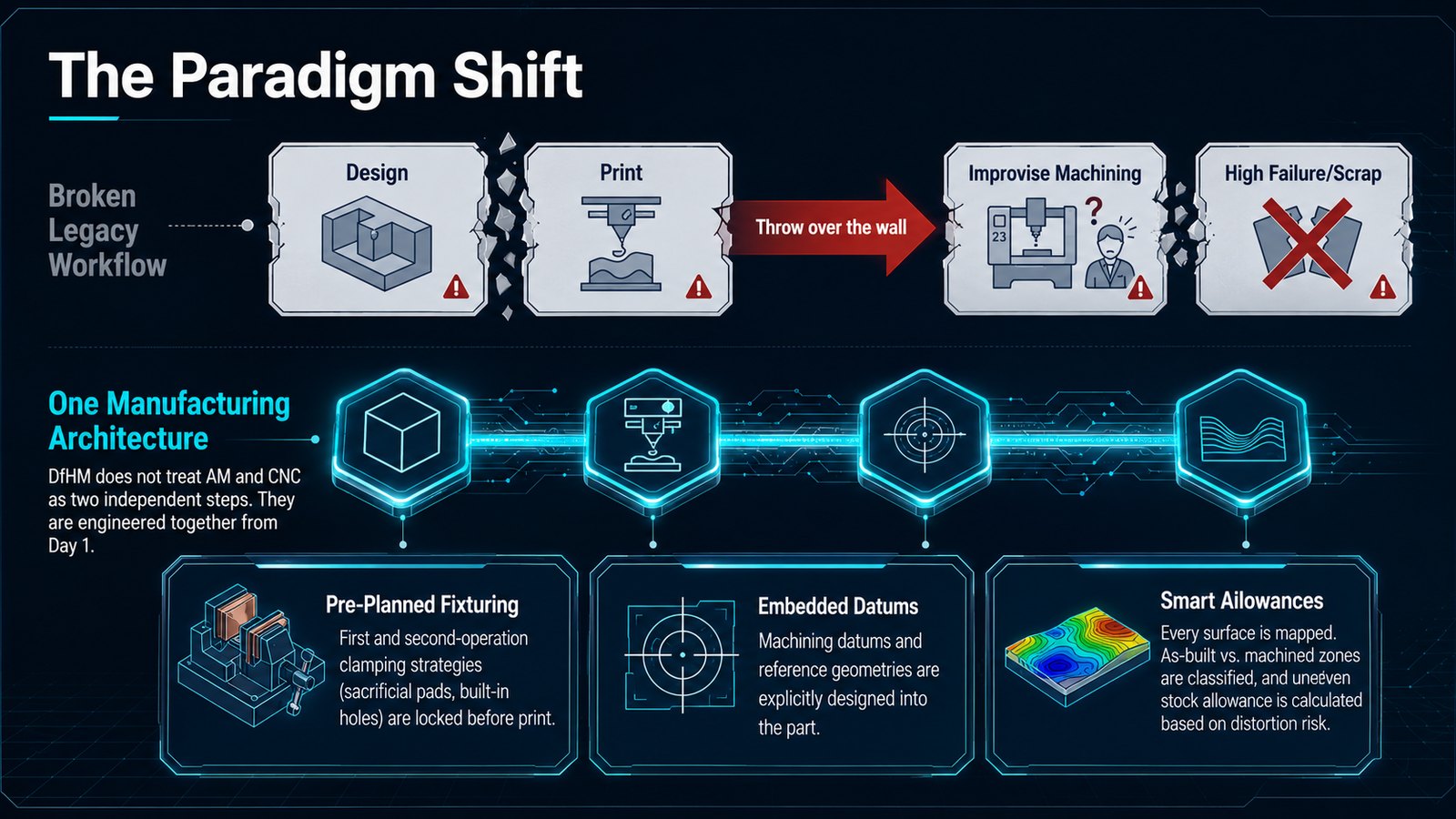
Why this is not a generic DfM review
| Generic DfM review | Process-chain engineering | |
|---|---|---|
| Scope | One process at a time | The full route, from blank to inspected part |
| Question asked | Can this feature be made? | Can the next process reference, hold, cut and measure what this process produced? |
| Output | A list of design comments | Route, datum chain, stock map, fixturing, machining and inspection strategy |
| When risk surfaces | On the shop floor | In the virtual environment, before material is committed |
From valid geometry
to repeatable production.
Forgefront does not stop at simulation or optimized CAD. We take components through new product introduction into stable, documented production — with qualified suppliers and defined quality gates.
- 01
Technical discovery
Design data, manufacturing baseline and supply chain assessed. Risk nodes and qualification gaps identified before any commitment.
- 02
Process architecture
Route, sequencing, quality gates and supplier qualification framework — each decision traceable to a cost or schedule objective.
- 03
Pilot production
Controlled first-article builds. Parameters locked, inspection records established, non-conformances root-caused before volume.
- 04
Production transfer
Documented process, quality plan and supplier set handed to your operations team, with ongoing support.
Scope covered
Typical deliverables
Engineering intelligence.
Available today.
Expert-led engagements, scoped per component or program. Each one applies the same process-chain logic the platform is being built on — you do not need to wait for software.
Advanced design engineering
Topology optimization, generative design, lightweighting, FEA, lattice structures, design reconstruction and manufacturability adaptation.
- Input
- Design space, load cases, targets, constraints
- Output
- Production-oriented engineering design
Manufacturing readiness review
A structured review of an existing design before it goes to suppliers.
- Input
- CAD, drawings, functional requirements
- Output
- Manufacturing risk map, DfM findings, process recommendation, datum strategy, tolerance review, machining and inspection considerations
Process-chain engineering
The full route engineered as one architecture, for parts where hand-overs between processes carry the risk.
- Input
- Component geometry, production requirements
- Output
- Recommended production route, manufacturing risk analysis, design modifications, stock strategy, datum chain, fixturing, machining strategy, inspection architecture
Industrialization program
For customers moving from prototype to repeatable production.
- Scope
- NPI, supplier engineering, manufacturing readiness, FAI, process validation, quality gates, supplier qualification, pilot production
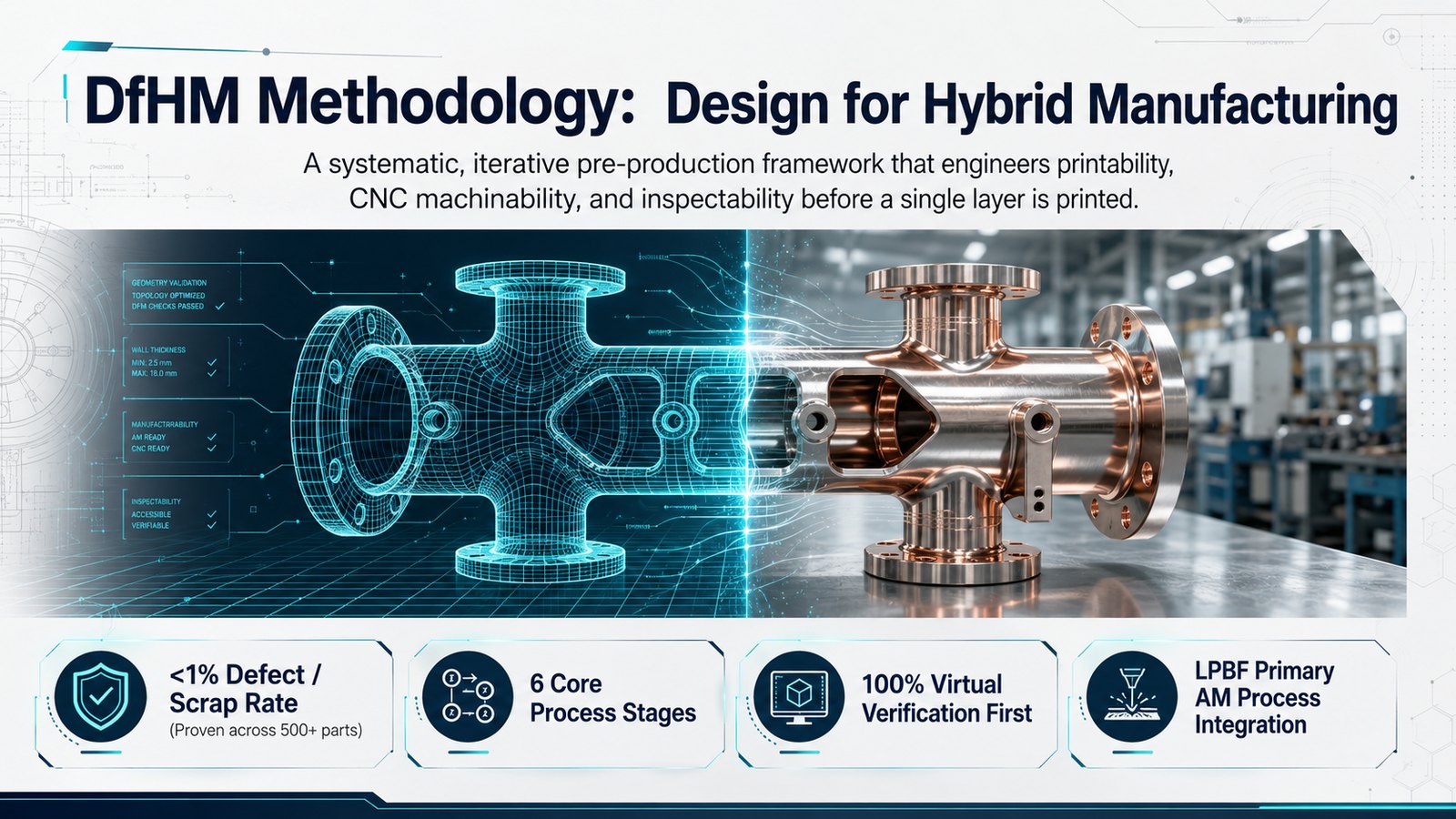
DfHM engineering package
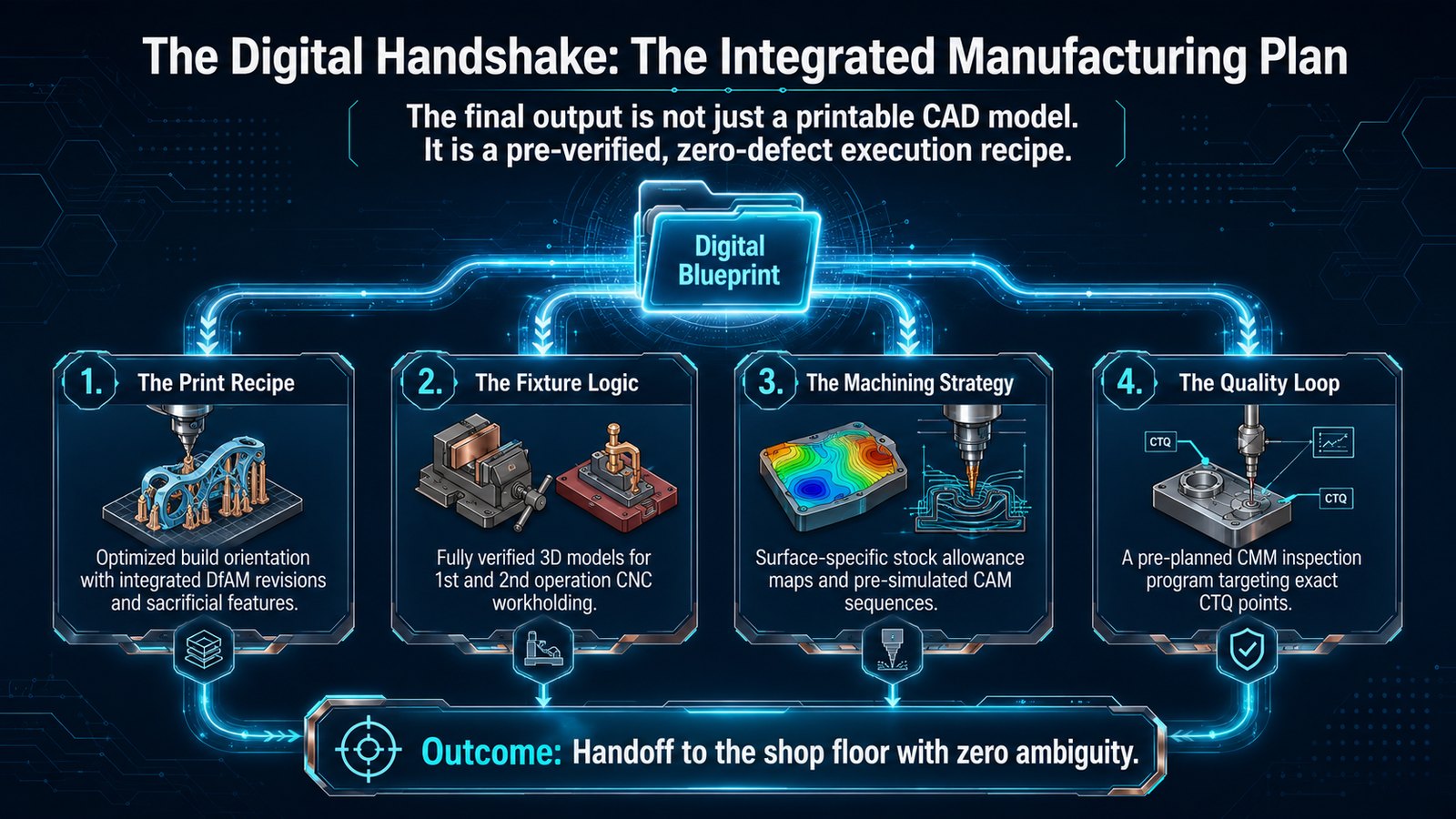
The full DfHM methodology applied to a metal additive part, delivered as an integrated manufacturing blueprint.
- Print recipe — build orientation, DfAM revisions, sacrificial features
- Fixture logic — verified 3D models for 1st and 2nd operation workholding
- Machining strategy — surface-specific stock allowance maps, pre-simulated CAM
- Quality loop — CMM program planned against exact CTQ points
From engineering knowledge
to engineering automation.
Forgefront is converting process-chain manufacturing logic into a scalable engineering automation architecture — a platform that transforms CAD designs into production-ready manufacturing strategies.
Machines already automate motion.
The missing layer is decision logic.
Automated LPBF platforms, lights-out CNC cells with zero-point workholding and autonomous CMMs already exist. What does not exist is structured manufacturing logic that tells them how a part should be referenced, held, machined and verified.
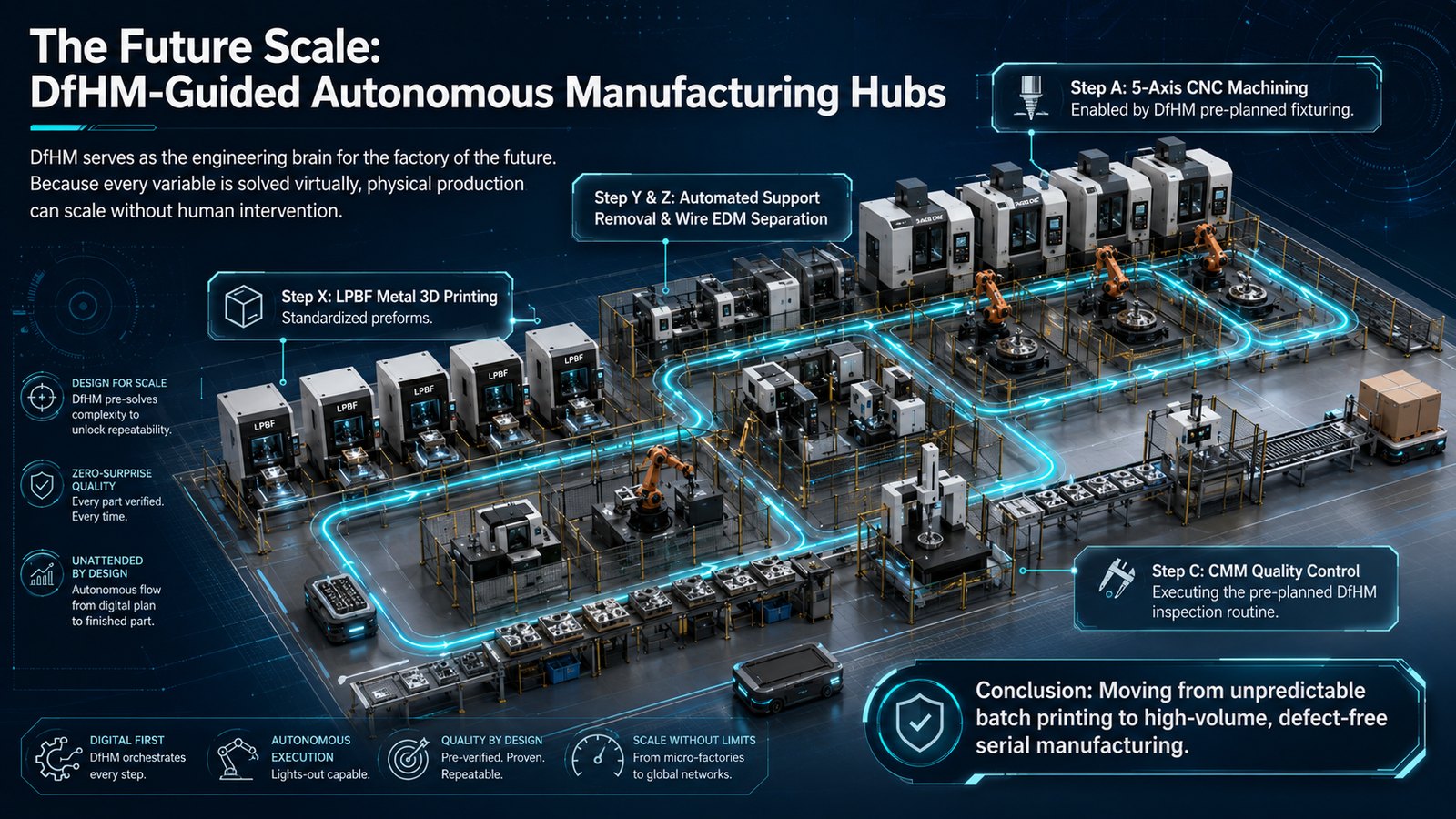
The next manufacturing breakthrough will not come from a single machine. It will come from a connected system that can print, machine, inspect, learn and release parts with minimal human intervention. The building blocks already exist independently. The remaining challenge is connecting them.
A robot can transfer a part and a CNC machine can execute a programme, but the system must still know whether the part is ready for machining, how it should be referenced, which areas are deformation-sensitive, and whether a deviation is recoverable. Forgefront's role is not to replace CAM, simulation or metrology platforms — it is to supply the process-chain intelligence that connects them.
A decision layer, not another CAM system
The platform is designed to guide existing CAD, simulation and CAM tools — telling them what to do, not replacing them.
Engineering reasoning first
Computational geometry, manufacturing rules, process knowledge, optimization, simulation and engineering heuristics. Machine learning is the later scaling layer, not the foundation.
Engineers stay in control
Recommendations are explained and reviewable. Engineers accept, adjust or reject — and those decisions refine the rule base.
The manufacturing
process-chain engine.
How a design moves through the platform: from geometry and intent, through process capability, into a reasoned production strategy.
- 01Detect
Identify manufacturability and process-chain risks.
- 02Explain
Describe why the geometry creates manufacturing risk.
- 03Propose
Recommend design or process changes.
- 04Adapt
Modify, or guide modification of, the geometry.
- 05Validate
Re-evaluate the revised component.
- 06Industrialize
Generate the production strategy.
Detect → Explain → Propose → Adapt → Validate → Industrialize
Structured expert methodology
DfHM applied as a defined, repeatable engineering workflow in client projects.
Guided expert workflow
STEP and drawing input, engineer-tagged critical surfaces, structured stage-by-stage decisions.
Structured decision database
Every reviewed decision captured as reusable rules, dependencies and risk models.
Recommendation & reasoning engine
Automated process-chain reasoning across additive, casting and forging routes.
DfHM.
Where the platform began.
Forgefront's first proprietary process-chain methodology — and the first application of the broader manufacturing intelligence architecture.
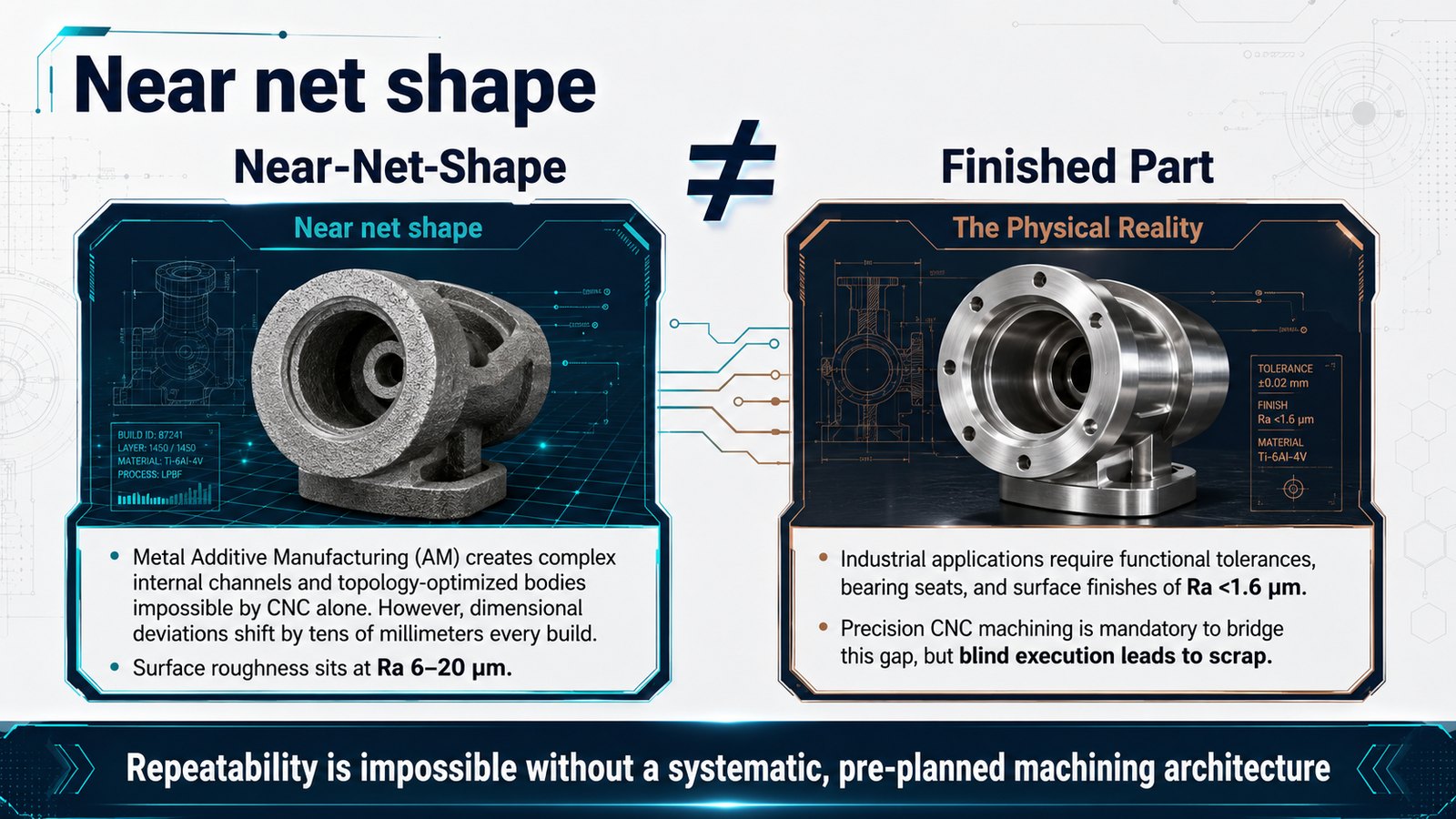
Near-net-shape is not a finished part
As-built AM parts carry distortion, residual stress and Ra 6–20 µm surfaces. Functional interfaces need precision machining.
AM and machining cannot be engineered in sequence
Fixturing, datums and stock are decided by the print. Designed afterwards, they are improvised.
Additive, machining and inspection in one plan
Six iterative stages resolve the route virtually before a layer is printed.
Decisions as repeatable logic
The rules, dependencies and iterative logic developed through DfHM provide the initial engineering architecture for broader process-chain automation.
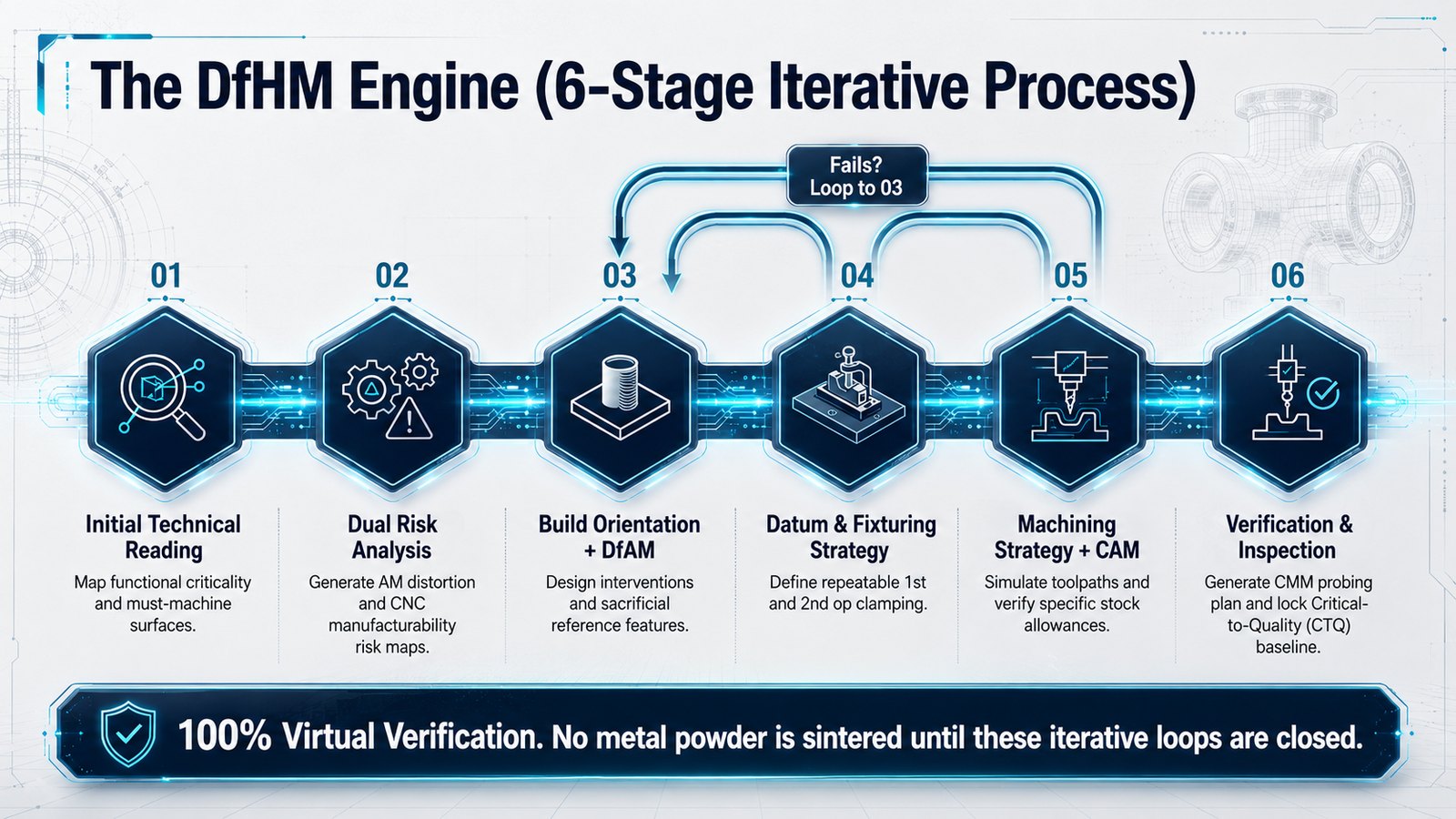
The DfHM route
- Additive
LPBF build, oriented and featured for what comes next.
- Thermal / post-process
Stress relief and heat treatment before precision work.
- Datum creation
Reference geometry designed in before printing.
- Fixturing
1st and 2nd operation workholding defined and verified.
- CNC machining
Surface-specific stock removed with simulated CAM.
- CMM verification
CTQ points measured with a pre-planned probe program.
Field record of the methodology
Recorded by the founder in production before Forgefront was established; the methodology carries forward into Forgefront's engagements.
Initial technical reading
The part is evaluated as a functional component, not merely a geometric model.
- Functional criticality map
- Must-machine surface list
- Sector and system risk context
- CMM CTQ baseline
Dual risk analysis
AM risk and CNC risk are mapped in parallel, before any design decision is made.
- AM distortion and support risk zones
- CNC fixturability assessment
- Tool access and spindle clearance
- Production blockers identified
Decision Center for DfAM & DfM (DCFD)
Orientation is chosen from combined AM and CNC risk data. All downstream failures return here until every stage passes in simulation.
- Sacrificial clamping features
- Datum and reference surfaces
- Surface-specific stock allowances
- CNC and CMM access
Datum & fixturing strategy
When the part reaches the CNC machine, clamping, referencing and sequence are already defined.
- 1st-op fixture designed and verified
- Datum chain: 1st op → 2nd op → CMM
- Clamping repeatability confirmed
- Failure → return to stage 03
Allowance & CAM simulation
Each surface receives its own allowance based on distortion risk, geometry and orientation. Full CAM collision analysis before cutting.
- Allowance per face
- 1st and 2nd op CAM simulated
- Collision analysis passed
- Failure → return to stage 03
CMM verification
The measurement program is simulated before the part exists — probe access, datum alignment and every CTQ point.
- CTQ points mapped
- CMM program simulated pre-build
- Probe path and collision verified
- CNC–CMM datum chain closed
What a DfHM plan contains
Build orientation locked with distortion analysis
DfAM revisions completed for CNC and CMM readiness
CNC reference and datum chain defined
Fixturing strategy verified for each operation
Surface-specific machining allowance per face
1st and 2nd operation CAM simulations verified
CMM measurement strategy simulated pre-production
Functional tolerance risk reduced before the first layer
One reasoning architecture.
Many production routes.
DfHM solves additive-to-machining. The same structure — references, workholding, stock, access, verification — applies wherever a near-net blank becomes a finished part.
DfHM. Proven in production, applied in client engagements.
Cast datum planning, allowance and workholding as structured logic.
Forging envelope, stock and downstream CNC strategy as structured logic.
Additional production routes on the same architecture.
- 01Customer engineering problem
A part that is hard to make, hold, machine or verify.
- 02Consulting engagement
Expert-led engineering solves it today.
- 03Real manufacturing validation
The solution is tested on physical parts.
- 04Structured engineering knowledge
Methodology refinement and manufacturing rule development.
- 05Automation logic
Rules and dependencies encoded.
- 06Software capability
Guided workflows, then recommendations.
- 07Faster, scalable engineering
More parts reviewed per engineer.
- 08More industrial validation
Back to new customer problems.
The platform is built from validated engineering knowledge and methodology refinement. Client data and drawings remain the client's.
Where engineering
meets reality.
Physical production is how Forgefront's engineering is proven. Through qualified partner production infrastructure, we execute prototypes, first articles and pilot builds — and feed what we learn back into the methodology.
What physical production provides
Validation
Engineering decisions tested against real parts.
Prototype execution
Functional prototypes built on the intended route.
First-article production
FAI parts with documented inspection.
Pilot builds
Small series that prove repeatability.
Manufacturing feedback
Shop-floor results returned to the methodology.
Inspection evidence
CMM data that closes the design-to-production loop.
Metal additive,
planned for what follows.
L-PBF for complex metal geometry — internal channels, organic load paths, lattice-filled sections — built with datum surfaces, interfaces and thread bosses deliberately left with stock for precision machining. Polymer processes support fixtures, soft jaws and prototypes.
- L-PBF build
Inconel, titanium and stainless alloys at typical 20–60 µm layers, oriented from the combined AM and CNC risk analysis.
- Thermal stabilization
Stress relief and alloy-specific heat treatment before any precision work; for Inconel, solution annealing and aging cycles.
- 5-axis precision machining
Critical stock removed from mating surfaces, bores, threads and sealing faces, with CAM adapted to AM material behaviour.
- Metrological validation
Each part measured against nominal CAD by CMM to micron-level accuracy, with full GD&T verification.
Precision machining
on irregular blanks.
The step where most AM, cast and forged parts succeed or fail. Machining is executed on partner CNC infrastructure to Forgefront's fixture logic, datum chain and simulated CAM.
- Axes
- 3-axis · 5-axis simultaneous · mill-turn
- Workholding
- Zero-point systems, custom fixture plates, soft jaws, sacrificial features
- Materials
- Aluminium, steel, stainless steel, Inconel, titanium, copper
- Tolerances
- Per drawing — critical features engineered into the process strategy
- Finishing
- A-class automotive-grade painting and finishing; 1:1 scale model making for design studios
Engineered by us.
Produced by qualified partners.
Casting and forging are executed by qualified foundry and forging partners selected per program. Forgefront owns the engineering of the route: blank definition, allowance, datums, workholding, machining and inspection.
Inspection planned
before the part exists.
Quality is not a final step. CTQ points, probe access and datum alignment are defined at design stage, so the measurement confirms a plan instead of discovering a problem.
CMM verification
Micron-level measurement against nominal CAD.
Full GD&T
True position, cylindricity, flatness, profile.
Probe-path planning
Access and collisions checked in simulation.
Documentation
FAI, in-process and final dimensional reports.
Material library
High-temperature strength to around 700 °C. Precipitation-hardenable. Turbine and hot-section components.
Corrosion and oxidation resistance with good weldability. Marine, chemical and energy applications.
Exceptional strength-to-weight. Biocompatible. Aerospace structures, defence and medical implants.
Low-carbon, corrosion-resistant. Medical, marine and chemical processing parts.
Lightweight, good thermal conductivity, strong after T6. The dominant alloy for structural AM in automotive and aerospace.
Weldable, formable. Fluid systems, enclosures and precision structural parts.
As-rolled or heat-treated to Rc 20–54. High fatigue resistance for structural and tooling parts.
Extreme chemical resistance, continuous use up to 250 °C. Aerospace, medical and oil & gas parts.
FST-rated grade for aircraft interiors. High strength-to-weight with good layer adhesion in FDM.
Sterilizable jigs, fixtures and medical-grade parts. Autoclave and radiation resistant.
Where the hardest
transitions live.
Sectors where components are high-value, geometrically complex and expensive to scrap — and where the hand-over between processes decides whether a part qualifies.
Aerospace
Typical parts: brackets, housings, manifolds, hot-section components.
Lightweighting and AM-to-CNC routes for superalloy and titanium parts.
Space
Typical parts: propulsion components, structural nodes, thermal hardware.
Mass-critical geometry with internal channels and tight interfaces.
Defense
Typical parts: low-volume, high-complexity mechanical components.
Repeatable routes for small series where every scrap part is costly.
Mobility & automotive
Typical parts: motorsport and EV structural parts, prototypes, 1:1 design models.
Casting and forging routes, lightweighting and prototype-to-series transfer.
Energy
Typical parts: turbine and flow components, heat exchangers.
Thermal applications of lattices and conformal channels, with machined interfaces.
Semiconductor & high-tech equipment
Typical parts: precision frames, manifolds, fixtures, vacuum components.
Tight-tolerance machining and inspection planning on complex blanks.
Industrial machinery
Typical parts: housings, tooling, wear parts, consolidated assemblies.
Process selection and supplier industrialization for cost and lead time.
Advanced R&D
Typical parts: research prototypes and test articles.
Fast, verified routes from concept geometry to measured hardware.
Forgefront does not claim sector-specific approvals of its own. Where a program requires certified production, work is executed under the quality system of a qualified production partner, with Forgefront responsible for the engineering.
An unusual origin
for systems thinking.

Trained in architecture and spatial systems thinking, H. Gökhan Akerdem built his career in advanced manufacturing, industrialization and production engineering — spanning additive manufacturing, CNC machining, manufacturing strategy, supplier industrialization and design for manufacture.
More than ten years in industrial AM, CNC machining and hybrid manufacturing — including engineering and quality leadership roles, and founding and running his own hybrid manufacturing workshop. Across 200+ industrial projects, he developed DfHM and validated it on 500+ metal parts at a sub-1% defect rate.
Advanced manufacturing and computational design training experience within the Autodesk ecosystem — generative design, topology optimization, additive manufacturing and CAD/CAM workflows.
Forgefront was founded around a recurring industrial problem: design software, manufacturing processes and quality systems are sophisticated individually, but the engineering decisions between them remain fragmented. Architecture trains you to resolve many constraints in one form. Manufacturing showed where that discipline was missing.
To convert this accumulated manufacturing logic into scalable engineering automation — starting with DfHM, and extending across casting, forging and further production routes.
Design-to-production engineering automation
Process-chain-aware manufacturing intelligence
DfHM — Design for Hybrid Manufacturing
Engineering consulting and industrialization
Turkey · Germany · United States
Qualified partner manufacturing network
Start with
one component.
Send the part that is hardest to industrialize, or the question you are weighing. Engagements begin with a confidential technical briefing; an NDA is available on request.
An engineering or industrialization problem
Advanced design, manufacturing readiness, process-chain engineering, DfHM or an industrialization program.
Co-development and validation
Research institutions, software vendors and manufacturers interested in process-chain automation.
The platform and the company
Conversations about the technology roadmap and strategic collaboration.